Some Foods Are Preserved With Heat and Then Cooled Again Before Ever Reaching a Food Service
Nutrient Safety, Sanitation, and Personal Hygiene
4 Preventing Foodborne Disease
Food-handling and Storage Procedures
Proper food handling and storage tin preclude near foodborne illnesses. In order for pathogens to grow in nutrient, sure weather must be present. By controlling the surround and conditions, fifty-fifty if potentially harmful bacteria are present in the unprepared or raw nutrient, they will not exist able to survive, grow, and multiply, causing illness.
There are six factors that bear on bacterial growth, which can be referred to by the mnemonic :
- Food
- Acid
- Temperature
- Time
- Oxygen
- One thousandoisture
Each of these factors contributes to bacterial growth in the following ways:
- Food: Bacteria require nutrient to survive. For this reason, moist, protein-rich foods are good potential sources of bacterial growth.
- Acid: Bacteria exercise not abound in acidic environments. This is why acidic foods like lemon juice and vinegar do not support the growth of bacteria and tin be used equally preservatives
- Temperature: About leaner volition grow rapidly between 4°C and 60°C (forty°F and 140°F). This is referred to equally the (see the department below for more information on the danger zone).
- Time: Leaner crave time to multiply. When small-scale numbers of leaner are present, the risk is normally low, merely extended time with the right weather condition will let the bacteria to multiply and increment the take a chance of contamination
- Oxygen: There are 2 types of bacteria. require oxygen to grow, so will not multiply in an oxygen-free surroundings such as a vacuum-packaged container. will only abound in oxygen-gratuitous environments. Nutrient that has been improperly candy and so stored at room temperature can be at risk from anaerobic bacteria. A common example is a production containing harmful Clostridium botulinum (botulism-causing) bacteria that has been improperly processed during canning, and then is consumed without any further cooking or reheating.
- Moisture: Bacteria demand moisture to survive and will grow rapidly in moist foods. This is why dry out and salted foods are at lower risk of being hazardous.
Identifying Potentially Hazardous Foods (PHFs)
Foods that have the FATTOM weather are considered . PHFs are those foods that are considered perishable. That is, they will spoil or "go bad" if left at room temperature. PHFs are foods that support the growth or survival of disease-causing bacteria (pathogens) or foods that may be contaminated by pathogens.
Generally, a food is a PHF if it is:
- Of animal origin such equally meat, milk, eggs, fish, shellfish, poultry (or if it contains any of these products)
- Of plant origin (vegetables, beans, fruit, etc.) that has been heat-treated or cooked
- Any of the raw sprouts (bean, alfalfa, radish, etc.)
- Any cooked starch (rice, pasta, etc.)
- Any type of soya protein (soya milk, tofu, etc.)
Table ii identifies mutual foods as either PHF or not-PHF.
| PHF | Non-PHF |
|---|---|
| Chicken, beef, pork, and other meats | Beef jerky |
| Pastries filled with meat, cheese, or cream | Bread |
| Cooked rice | Uncooked rice |
| Fried onions | Raw onions |
| Opened cans of meat, vegetables, etc. | Unopened cans of meat, vegetables, etc. (as long as they are not marked with "Keep Refrigerated") |
| Tofu | Uncooked beans |
| Coffee creamers | Cooking oil |
| Fresh garlic in oil | Fresh garlic |
| Fresh or cooked eggs | Powdered eggs |
| Gravy | Flour |
| Dry soup mix with water added | Dry soup mix |
The Danger Zone
One of the near important factors to consider when handling food properly is temperature. Table 3 lists the near temperatures to be enlightened of when handling food.
| Celsius | Fahrenheit | What happens? |
|---|---|---|
| 100° | 212° | Water boils |
| sixty° | 140° | Almost pathogenic bacteria are destroyed. Keep hot foods in a higher place this temperature. |
| twenty° | 68° | Food must be cooled from 60°C to 20°C (140°F to 68°F) within two hours or less |
| four° | 40° | Nutrient must be cooled from xx°C to iv°C (68°F to twoscore°F) within four hours or less |
| 0° | 32° | H2o freezes |
| –18° | 0° | Frozen food must be stored at −xviii°C (0°F) or below |
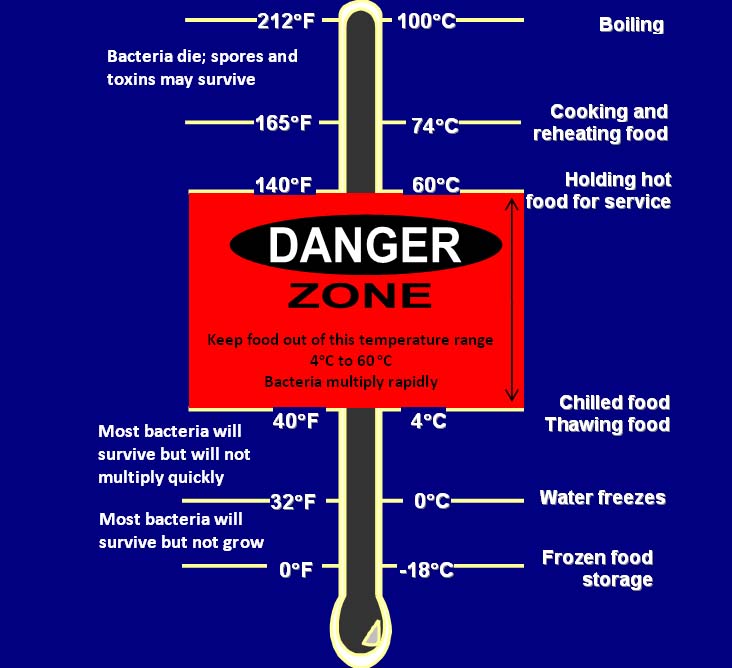
The range of temperature from four°C and 60°C (40°F and 140°F) is known as the , or the range at which near pathogenic leaner will grow and multiply.
Time-temperature Command of PHFs
Pathogen growth is controlled by a time-temperature relationship. To kill micro-organisms, food must be held at a sufficient temperature for a sufficient time. Cooking is a scheduled procedure in which each of a series of continuous temperature combinations tin can be equally constructive. For case, when cooking a beef roast, the microbial lethality achieved at 121 minutes after it has reached an internal temperature of 54°C (130°F) is the aforementioned equally if it were cooked for 3 minutes subsequently it had reached 63°C (145°F).
Tabular array 4 show the minimum time-temperature requirements to continue food rubber. (Other fourth dimension-temperature regimens might exist suitable if it can be demonstrated, with scientific data, that the regimen results in a safe nutrient.)
| Disquisitional control indicate | Type of food | Temperature |
|---|---|---|
| Refrigeration | Cold food storage, all foods. | 4°C (forty°F) or less |
| Freezing | Frozen food storage, all foods. | −xviii°C (0°F) or less |
| Freezing | Parasite reduction in fish intended to be served raw, such as sushi and sashimi | −20°C (−4°F) for 7 days or −35°C (−31°F) in a boom freezer for 15 hours |
| Cooking | Food mixtures containing poultry, eggs, meat, fish, or other potentially hazardous foods | Internal temperature of 74°C (165°F) for at least 15 seconds |
| Cooking | Rare roast beef | Internal temperature of 54°C to threescore°C (130°F to 140°F) |
| Cooking | Medium roast beef | Internal temperature of 60°C to 65°C (140°F to 150°F) |
| Cooking | Pork, lamb, veal, beef (medium-well) | Internal temperature of 65°C to 69°C (150°F to 158°F) |
| Cooking | Pork, lamb, veal, beef (well done) | Internal temperature of 71°C (160°F) |
| Cooking | Poultry | Internal temperature of 74°C (165°F) for 15 seconds |
| Cooking | Stuffing in poultry | 74°C (165°F) |
| Cooking | Ground meat (Includes chopped, ground, flaked, or minced beef, pork, or fish) | seventy°C (158°F) |
| Cooking | Eggs[1] | 63°C (145°F) for 15 seconds |
| Cooking | Fish[2] | 70°C (158°F) |
| Holding | Hot foods | 60°C (140°F) |
| Cooling | All foods | sixty°C to 20°C (140°F to 68°F) within two hours and twenty°C to 4°C (68°F to 40°F) inside iv hours |
| Reheating | All foods | 74°C (165°F) for at least fifteen seconds |
The Top ten List: Do's and Don'ts
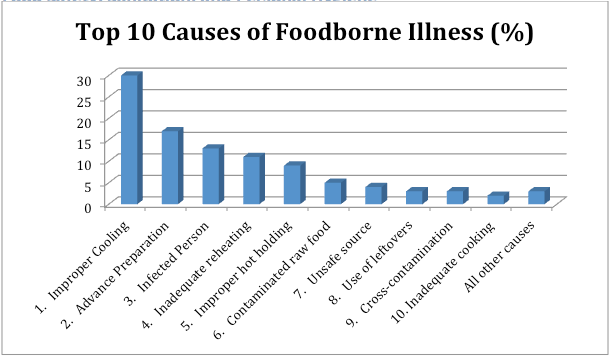
Figure 1 illustrates the top 10 improper food-handling methods and the pct of foodborne illnesses they cause.
This section describes each food-treatment practise outlined in the top x list and the means to prevent each trouble.
1. Improper cooling
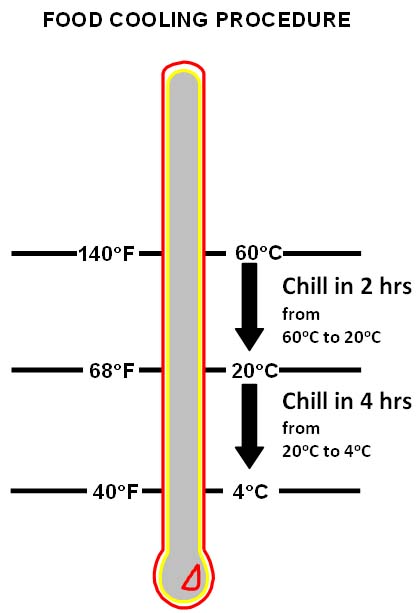
Many people think that once a food has been properly cooked, all disease-causing organisms (pathogens) have been killed. This is not true. Some pathogens can form estrus-resistant spores, which tin can survive cooking temperatures. When the food begins cooling downwardly and enters the danger zone, these spores begin to grow and multiply. If the food spends too much time in the danger zone, the pathogens will increase in number to a point where the nutrient will brand people sick. That is why the process is crucial. Cooked food must be cooled from 60°C to xx°C (140°F to 70°F) in two hours or less, AND and so from twenty°C to iv°C (70°F to 40°F) in four hours or less.
Even in modern walk-in coolers, large cuts of meat volition not cool downward properly. Neither will whole poultry. Even big pots (4 Fifty/1 gal. or more) of soup, stews, gravy, etc., can accept a day or more than to cool to 4°C (forty°F). However, yous can cool these foods down quickly by using i or more of the following methods depending on the type of food being cooled:
- Place the nutrient in (with the nutrient no deeper than v cm/two in.) and put the pans in the cooler.
- When the nutrient is cooling, do not tightly cover. Doing so only seals in the heat.
- Do non stack the shallow cooling pans during the cooling pace. This will defeat the purpose of shallow panning by preventing cold air from reaching the food. You may need to add together more shelves to your cooler.
- Cutting big cuts of meat or whole poultry into smaller or thinner portions. Then place these portions into shallow pans for cooling.
- Employ or cooling sticks to cool foods apace.
- Use rapid cooling equipment such as walk-in coolers with wire shelving and good air period. Habitation-way refrigerators or reach-ins do non cool food well.
- Stir the nutrient in a container placed in an ice-water bath.
- Use containers that assistance oestrus transfer, such as stainless steel or aluminum. Plastic does non transfer rut well.
- Utilize ice equally an ingredient (e.chiliad., in stews or soups).
- For big pots of cooked desserts (e.g., custard), divide it into serving sizes and and then cool.
two. Advance preparation
Advance preparation is the cause of many nutrient-poisoning outbreaks, usually because nutrient has been improperly cooled. Often, foods that are prepared well before serving spend too much time in the danger zone. This may happen for one or more than of the following reasons:
- The food is left out at room temperature too long.
- The nutrient is not heated or reheated properly (to a high plenty temperature), or not cooled properly.
- The nutrient is brought in and out of the danger zone too many times (east.g., cooked, hot held, cooled, reheated, hot held, cooled, reheated again).
To preclude problems of advance preparation:
- Try to fix all foods for aforementioned-day utilize and every bit close to serving time every bit possible.
- To prevent outside contamination of foods prepared in advance, cover them tightly after they have been properly cooled.
- Reheat leftovers just one time. If leftovers are non consumed after being reheated, throw them out.
- For foods prepared and held refrigerated in the cooler for more than 24 hours, mark the date of preparation and a "serve by" date. More often than not, PHFs should be thrown out if not used inside iii days from date they were made.
- If you must prepare foods in advance, be sure you properly cool and refrigerate them.
3. Infected person
Many people carry pathogens somewhere on or in their bodies without knowing it—in their gut, in their olfactory organ, on their hands, in their mouth, and in other warm, moist places. People who are conveying pathogens often accept no outward signs of illness. However, people with symptoms of illness (diarrhea, fever, airsickness, jaundice, sore throat with a fever, hand infections, etc.) are much more than likely to spread pathogens to nutrient.
Another problem is that pathogens can exist present in the cooked and cooled food that, if given plenty time, tin notwithstanding grow. These pathogens multiply slowly merely they tin eventually achieve numbers where they tin can make people sick. This means that foods that are prepared improperly, many days before serving, still stored properly the entire time can make people sick.
Some pathogens are more dangerous than others (e.m., salmonella, East. coli, campylobacter). Fifty-fifty if they are only nowadays in low numbers, they tin can make people very sick. A food handler who is carrying these kinds of pathogens can hands spread them to foods – usually from their hands. is extra unsafe. Ready-to-eat nutrient gets no further cooking later on being prepared, so whatsoever pathogens volition not be killed or controlled by cooking.
To preclude bug:
- Make sure all nutrient handlers wash their hands properly afterward any job that could muddy their hands (e.g., using the toilet, eating, handling raw meats, blowing their nose, smoking).
- Food handlers with infected cuts on their hands or artillery (including sores, burns, lesions, etc.) must not handle nutrient or utensils unless the cuts are properly covered (eastward.k., waterproof bandage covered with a latex glove or finger cot).
- When using or , food handlers must still wash their hands. Besides, gloves or cots must be replaced if they are soiled, accept a pigsty, and at the end of each solar day.
- Food handlers with infection symptoms must not handle utensils or nutrient and should be sent home.
- Where possible, avoid direct paw contact with food – peculiarly ready-to-eat foods (e.1000., utilise plastic utensils plastic or latex gloves).
4. Inadequate reheating for hot belongings
Many restaurants set up some of carte items in advance or utilise leftovers in their units the side by side day. In both cases, the foods travel through the danger zone when they are cooled for storage and again when they are reheated.
Foods that are hot held before serving are particularly vulnerable to pathogens. In improver to travelling through the danger zone twice, fifty-fifty in properly operating hot hold units, the nutrient is close to the temperature that will let pathogens to grow.
To prevent problems:
- Practise not employ hot concur units to reheat food. They are not designed for this purpose. Instead, quickly reheat to 74°C (165°F) (and hold the food at that temperature for at least 15 seconds before putting it in the hot hold unit. This will kill any pathogens that may have grown during the absurd-downward step and the reheat step.
- If using direct heat (stove superlative, oven, etc.), the temperature of the reheated food must reach at least 74°C (165°F) for at least 15 seconds within two hours. Keep a thermometer handy to check the temperature of the food.
- If using a microwave, rotate or stir the food at to the lowest degree in one case during the reheat step, as microwaves oestrus unevenly. Also, the food must exist heated to at least 74°C (165°F) and and then stand up covered for ii minutes subsequently reheating before adding to the hot hold unit. The snapping and crackling sounds coming from food beingness reheated in a microwave practise not hateful the nutrient is hot.
five. Improper hot belongings
Hot hold units are meant to keep hot foods at sixty°C (140°F) or hotter. At or above this temperature, pathogens will not grow. However, a mistake in using the hot concur unit tin can event in foods being held in the – betwixt 20°C and 49°C (70°F and 120°F), temperatures at which pathogens abound very quickly.
To prevent problems:
- Brand sure the hot hold unit of measurement is working properly (e.g., heating elements are not burnt out; water is not too low in steam tables; the thermostat is properly set up and then nutrient remains at threescore°C (140°F) or hotter) Cheque it daily with a thermometer.
- Put just already hot (74°C/165°F) foods into the hot hold unit.
- Preheat the hot agree unit to at least 60°C (140°F) before you get-go putting hot foods into information technology.
- Do not use the hot agree unit to reheat common cold foods. Information technology is not designed for or capable of doing this rapidly.
- Subsequently the lunch or dinner rush, practice not plough off the heat in the hot agree unit and and so go out the food there to cool. This is very dangerous. When you lot do this, the nutrient does not absurd down. It stays hot in the super danger zone and lets pathogens grow rapidly. Foods in hot agree units should exist taken out of the units afterward the meal fourth dimension is over and cooled right abroad.
half dozen. Contaminated raw nutrient or ingredient
We know that many raw foods often contain pathogens, still certain foods are often served raw. While some people believe these foods served raw are "good for you," the truth is that they have always been dangerous to serve or eat raw. Some examples include:
- Raw oysters served in the beat out
- Raw eggs in certain recipes (e.g., Caesar salad, eggnog made from raw eggs)
- Rare hamburger
- Sushi/sashimi
- Steak tartare
These foods have caused many food-poisoning outbreaks. E'er remember: y'all cannot tell if a food contains pathogens merely by look, taste, or aroma.
To forestall problems:
- Buy all your foods or ingredients from approved suppliers.
- If available, buy foods or ingredients from suppliers who too take food safe plans for their operations.
- Where possible, apply candy or pasteurized alternatives (east.g., pasteurized liquid eggs).
- Never serve these types of foods to loftier-risk customers (east.m., seniors, young children, people in poor health, people in hospitals or nursing homes).
7. Unsafe source
Foods from canonical sources are less likely to contain high levels of pathogens or other forms of contamination. Approved sources are those suppliers that are inspected for cleanliness and safety by a government nutrient inspector. Foods supplied from unreliable or disreputable sources, while beingness cheaper, may contain high levels of pathogens that tin cause many food-poisoning outbreaks.
Fly-by-night suppliers (body sales) frequently do non care if the product is safe to sell to you lot, merely canonical suppliers do! Equally well, many fly-by-night suppliers have obtained their product illegally (e.g., closed shellfish fisheries, rustled cattle, poached game and fish) and oftentimes practise not have the equipment to properly procedure, handle, shop, and transport the nutrient safely.
Of particular business concern is seafood from unapproved sources. Seafood, especially shellfish, from unapproved sources tin be heavily contaminated with pathogens or poisons if they take been harvested from closed areas.
To prevent bug:
- Buy your food and ingredients from approved sources only. If yous are not sure a supplier has been approved, contact your local environmental health officer. He or she can find out for you.
- Practice non take the hazard of causing a food-poisoning outbreak by trying to save a few dollars. Remember, your reputation is on the line.
eight. Employ of leftovers
Using leftovers has been the cause of many outbreaks of food poisoning because of improper cooling and reheating (of "hot" leftovers). Leftovers that are intended to exist served hot pass through the danger zone twice (during the initial cooling of the hot food and when reheating). Those leftovers intended to be served without reheating, or as an ingredient in other foods (e.g., sandwich filler), go through the danger zone during cooling and then, when beingness prepared and portioned, often stay in the danger zone for another long period. The fourth dimension in the danger zone adds up unless the food is quickly cooled and so speedily reheated (if being served hot), or kept common cold until serving (if not existence served hot).
Contamination can as well occur with leftover foods when they are stored in the cooler. Improperly stored leftovers tin can accidentally be contaminated by raw foods (e.g., blood dripping from a college shelf).
To prevent problems:
- Reheat leftovers simply once. Throw out whatever leftovers that have already been reheated one time.
- Do not mix leftover foods with fresh foods.
- Be sure to follow the proper cooling and reheating procedures when handling leftovers. These are critical command points.
- Absurd leftovers in uncovered containers separate from whatsoever raw foods. After they are cooled, embrace them tightly.
nine. Cross-contamination
Y'all can expect sure foods to contain pathogens, especially raw meat, raw poultry, and raw seafood. Use extreme caution when you bring these foods into your kitchen. Cross-contamination happens when something that can cause illness (pathogens or chemicals) is accidentally put into a food where not previously constitute. This can include, for example, pathogens from raw meats getting into ready-to-eat foods like deli meats. Information technology can also include nuts (which some people are very allergic to) getting into a food that does non normally have nuts (e.g., tomato sauce).
To preclude problems:
- Employ split cutting boards, separate cleaning cloths, knives/utensils, sinks, preparation areas, etc., for raw and for set up-to-eat foods. Otherwise, wash all of these items with detergent and them with bleach between use.
- Employ separate storage areas for raw and set up-to-eat foods. Always store set-to-swallow foods on separate shelves and above raw foods. Shop dry foods above wet foods.
- Prepare set-to-eat foods at the showtime of the day earlier the raw foods are prepared.
- Afterward treatment raw foods, always wash your easily properly before doing anything else.
- Go on wiping or cleaning cloths in a container of fresh bleach solution (30 mL/ane oz. of bleach per iv 50/ane gal. of water) when not in apply.
- Utilize clean utensils, not your hands, to handle cooked or set up-to-eat foods.
- If a customer indicates a food allergy, follow all the same steps to avoid cross contagion and use separate or freshly sanitized tools and utensils to prepare food for the individual with the allergy.
10. Inadequate cooking
Proper cooking is i of the best means of making sure your functioning does not cause a food-poisoning outbreak. Proper cooking kills all pathogens (except spores) or at least reduces their numbers to a bespeak where they cannot brand people ill. Inadequate cooking is often done past accident: for case, cooking however-frozen poultry or meat; attempting to cook a blimp bird using the aforementioned fourth dimension and temperature as an unstuffed bird; using an inexperienced melt.
To prevent issues:
- Don't rely on cooking times alone. Check the of the food existence cooked.
- For big cuts of meat or large batches of food, bank check the temperature in several spots.
- Be extra careful when cooking partially frozen foods. There tin be cold spots in the nutrient that are not properly cooked. The normal cooking time will accept to exist increased.
- When grilling or frying meat, cook until the juices run articulate. Cooked fish until information technology flakes easily. Brand thin, not thick, hamburgers.
Image descriptions
Figure 1 image description:
At 100°C (or 212°F), water boils. Higher up 74°C (or 165°F), bacteria dice, although spores and toxins may survive. Food that is being cooked or reheated should hit 74°C (or 165°F). Y'all can agree hot food for service at 60°C (or 140°F). Betwixt 4°C and lx°C (or 40°F and 140°F) is the "Danger Zone." Keep nutrient out of this temperature range considering leaner volition multiply speedily. Between 0°C and 4°C (or 32°F and xl°F), virtually bacteria will survive but will not multiply quickly. Water freezes at 0°C (or 32°F). Betwixt 0°C and −18°C (or 0°F and 32°F), most bacterial will survive but not grow. Frozen food is stored at −eighteen°C (or 0°F).
[Render to Effigy i]
Figure ii paradigm clarification:
- Improper cooling, 30%.
- Accelerate preparation, 15%.
- Infected person, 12%.
- Inadequate reheating, 10%.
- Improper hot holding, 8%.
- Contaminated raw food, 4%.
- Dangerous source, 3%.
- Use of leftovers, two%.
- Cross-contamination, two%.
- Inadequate cooking, 1%.
- All other causes, 3%.
[Render to Figure 2]
Source: https://opentextbc.ca/foodsafety/chapter/preventing-foodborne-illness/
0 Response to "Some Foods Are Preserved With Heat and Then Cooled Again Before Ever Reaching a Food Service"
Post a Comment